

'Merry Christmas' in Spanish is 'Feliz Navidad.' Father Christmas is Papá Noel.
In Spain, Christmas celebrations begin from the 8 December. This date is el día de la Inmaculada Concepción. It is a celebration in honour of the Virgin Mary - la Virgen María. There are processions with music and singing. It is a national holiday.
On 8 December, Spanish families begin to decorate - adornar - their Christmas trees and houses.
el árbol de Navidad - the Christmas tree
los adornos navideños - the Christmas decorations


This painting of La Inmaculada is by the Spanish artist, Murillo (1617 - 1682).
The painting is kept at el Museo del Prado in Madrid.
From the 8 December, in the Catalan area of Spain, families place a special Christmas log in a prominent position in the house. Nowadays, the log has a painted face and stands on legs! It is called el tió de Nadal.

The log is kept covered with a blanket and is looked after like a pet until Christmas Day.
Children make sure that he is kept warmly covered and pretend to feed him every day, just like feeding a doll.
Then, on Christmas Day, children have fun hitting the log with a stick whilst singing a traditional song.
Pregunta / Question: Why do they hit the log?
Respuesta / Answer: To make it produce little gifts!
After singing the song and hitting the log with a stick, they put their hands under the cover to see if the log has produced anything. (When children aren't looking, grown-ups place the gifts under the cover!)
Children keep singing songs and hitting the log to have more goodies. Eventually, when they can only find something like an onion or garlic, it means that the gifts have run out and the game is over!
Pregunta: Why does this tradition exist?
Respuesta: In the past, the idea of hitting the log to make it produce gifts was believed to bring good luck for the harvests during the next year.
If you want to buy one of these cute logs, then go to the famous Christmas market of Barcelona.
This market is called el mercado de Santa Lucía.
Please note that in Catalan el tió means 'the log'. In standard Castilian Spanish el tío means 'the uncle.' The accent is written over different letters. These two words, although they look and sound similar, are totally unrelated.
During the Christmas period, most Spanish houses will have un portal de Belén (a Christmas Nativity Scene). You can say un belén for short. El belén can be very beautiful and elaborate. It is a model of the stable with la Sagrada Familia (the Holy Family of Mary, Joseph and Jesus), el pastor (the shepherd), el ángel (the angel), los Reyes Magos (the Three Kings) and los animales (the animals).
Very often, Spanish children will sing Christmas carols (villancicos) whilst admiring el belén.
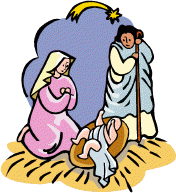
Vocabulario de la Navidad:
Some Christmas vocabulary:
María y José - Mary and Joseph
el Niño Jesús - the Baby Jesus
Belén - Bethlehem
el ángel - the angel
el burro - the donkey
la estrella de Belén - the star of Bethlehem
el pastor - the shepherd
el pesebre - the manger
el portal de Belén - the Nativity scene, the Christmas crib
el villancico - the Christmas carol
On the 22 December there is a famous Christmas lottery and its main prize is nicknamed El Gordo (The Fat One) because of the large amount of money that can be won.
On 24 December, the King of Spain makes a traditional Christmas Eve speech.
This speech is called el Discurso Nacional de Su Majestad el Rey and it is shown on the television.
Traditional Spanish ham is very popular at Christmas.
It is known as el jamón serrano. Another variety is el jamón ibérico.
The ham is sliced very thinly and eaten as an appetiser (una tapa) with bread (el pan).

¡Buen provecho!
A sweet nougat called el turrón, an almond pastry called un polvorón, marzipan - el mazapán, shortbread - el mantecado and sparkling Cava wine are also popular.
Nuts (nueces), mandarins (mandarinas) and dates (dátiles) are also part of Spanish Christmas food.

Churros con chocolate are long, thin fritters to dunk in a hot chocolate drink. It is a popular snack at Christmas time.
The night of Christmas Eve is very important in Spain. It is called la Nochebuena (the good night).
Families eat a special meal on the night of 24 December. This meal is called la cena de Nochebuena.
There are many foods prepared for this meal, such as:
lamb - el cordero
seafood - los mariscos
fish - el pescado
lobster - la langosta
pork - el cerdo
turkey - el pavo
On the night of Christmas Eve, many people attend Midnight Mass - la Misa del Gallo.
The night of Nochebuena is a time for family festivities. There is a Spanish saying:-
Esta noche es Nochebuena y no es noche de dormir.
Tonight is Christmas Eve and it's not a night for sleeping.
A Spanish tradition on Christmas Eve is pedir el aguinaldo. This literally means 'to ask for the Christmas bonus' and it is a form of 'carol singing'. Groups of singers knock on neighbours' doors and sing carols and play instruments in exchange for small gifts such as coins (monedas) or sweets (dulces). The typical instruments played are la pandereta - the tambourine, and a drum called la zambomba.

¡Vamos a cantar villancicos!
Christmas Day is el día de Navidad. Many Spanish children receive some gifts from Papá Noel (Father Christmas) but they receive their main gifts from the Three Kings (los Reyes Magos) on 6 January!
Lucky Spanish children!
Boxing Day is called el día de San Esteban or just San Esteban. This is Saint Stephen's Day and it is greatly celebrated in the region of Cataluña.
In Spain, the 28 December is similar to April Fools' Day because people play infantile tricks on one another. This day is called el día de los Santos Inocentes. It is a day to remember all the babies and young children of Bethlehem who were killed by King Herod's soldiers at the time of the birth of the Baby Jesus. The Baby Jesus is el Niño Jesús. King Herod is el rey Herodes.
In a town called Ibi, in the area of Alicante, on 28 December, it is the tradition for people to throw flour and eggs at each other! Everyone becomes completely white! This fun tradition is called 'Los Enharinados.' The word for flour is la harina.

New Year's Eve is called la Nochevieja (the old night). In Spain at New Year, it is the tradition to eat twelve grapes at midnight - one grape for each stroke of the clock and for each month of the year to come. Those who eat the twelve grapes believe they will have twelve months of good luck.
The grapes are known as las uvas de la suerte (the lucky grapes) or las doce uvas (the twelve grapes.)

The most important place to be at midnight for the New Year celebrations is la Puerta del Sol: the main square in the centre of Madrid.
The clock in the tower of the historic post office building (la Real Casa de Correos) in la Puerta del Sol is the official clock in Spain for announcing midnight. A New Year party is known as un cotillón.
To wish someone a 'Happy New Year' you can either say 'Feliz Año Nuevo' or 'Próspero Año Nuevo.'
The 6 January is the most important day of Christmas in Spain. It is known as The Day of The Kings - el día de los Reyes. This is the day that celebrates the arrival of the Three Kings at the stable in Bethlehem when they gave their gifts to the Baby Jesus. Therefore, in remembrance of presenting their gifts to the Holy Child, the Three Kings return each year, travelling throughout the night of 5 January and early hours of 6 January to bring gifts to the children of Spain!


The Three Kings are called los Reyes Magos. This name is a way of saying 'the Magic Kings'. They were 'magic' because they studied the stars and the planets to calculate future events. That is why they followed the star of Bethlehem: they just knew that it indicated the birth of a Divine King.
On the evening of 5 January, before going to bed, Spanish children write letters to los Reyes Magos, mentioning the gifts that they would like to receive. Their letters begin with the words: Queridos Reyes Magos de Oriente, meaning Dear Kings of the East.
After writing their letters, they place their shoes (zapatos) under the Christmas tree or in another area where the Kings will find them. Children also leave out plates of food for the Kings and bowls of water for their camels! (los camellos)
In the morning, hopefully children will find their shoes filled with treats and surrounded by presents!

In towns all over Spain there are processions on the 5 January.
The special procession is called la cabalgata de los Reyes Magos. It celebrates the journey of the Three Kings as they followed the star to find the Baby Jesus, carrying their gifts of gold, frankincense and myrrh. In Spanish, these gifts are called oro, incienso y mirra.
During the processions, sweets (los caramelos) are thrown into the crowd from the passing floats.
A special cake is prepared to celebrate the day of the Kings. It is called el roscón de Reyes. It is a ring-shape like a crown and is covered in coloured sweets. The colourful decoration represents the sparkling jewels in the crowns worn by the Kings - los Reyes Magos.

Inside the cake, there is a lucky charm (una sorpresa) in the form of a king figurine - una figura / una figurita de Rey Mago. The belief is that if you find the charm in your cake, it will bring you good luck for the new year and you will be crowned the king or queen of the party with a cardboard crown! (At the time of serving, the crown is placed in the centre of the cake).
una corona = a crown.
But beware! ¡Atención! The cake also contains a dried bean called un haba and if you find it in your slice of cake then you have to pay for the cost of purchasing el roscón! ¡Ay!

There is a traditional poem about el roscón de Reyes. Often it is recited before eating the cake:
Feliz Roscón de Reyes
He aquí el roscón de Reyes
Here is the Kings cake
tradición de un gran banquete
tradition of a grand banquet
en el cual hay dos sorpresas
in which there are two surprises
para los que tengan suerte.
for those who should be so lucky.
En él hay muy bien ocultas
Inside it there are well hidden
un haba y una figura:
a bean and a figurine:
el que lo vaya a cortar
the person who cuts it
hágalo sin travesuras.
do so without any mischief.
Quien en la boca se encuentre
Whoever happens to find in their mouth
una cosa un tanto dura
something so very hard
a lo peor es el haba
at worst it will be the bean
o a lo mejor la figura.
or at best it will be the figurine.
Si es el haba lo encontrado
If it is the bean that is found
este postre pagarás
you will pay for this dessert
mas si ello es la figura
but if it is the figurine
coronado y Rey serás.
crowned and King you will be.
iFeliz Navidad y Próspero Año Nuevo!
Christmas in Spain

A collection of worksheets to use with our Spanish Christmas webpages.
The questions involve Spanish Christmas / WInter & New Year traditions and vocabulary.
For Key Stage 2 and Year 7.
Primary Spanish Christmas Activities

This pack includes:
1. Christmas card templates.
2. A help-sheet for writing the cards.
3. A Christmas bookmark template.
4. Christmas vocabulary worksheets.
5. Christmas signs for walls and doors.